
Click Here for a Printer Friendly Version
The U.S. government’s fiscal year began on October 1, 2025, but Congress failed to pass a new budget, resulting in a government shutdown. Historically, shutdowns have had minimal impact on financial markets and, in some instances, may have even supported stock returns.
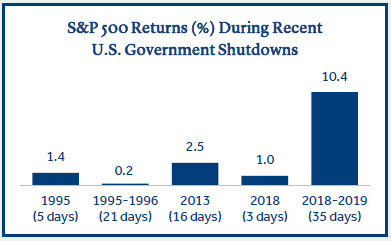
However, prolonged inaction by policymakers could harm the economy. For example, a Congressional Budget Office study found that the 35-day shutdown in 2018–2019 reduced economic output by 0.4%.
The current deadlock could also disrupt the job market. Approximately 750,000 federal workers have been furloughed, and permanent layoffs are possible if the situation persists.
Employment
The U.S. employment landscape weakened in 2025, and the ongoing government shutdown may worsen this fragile environment. Key challenges include:
1. Unemployment Surge: The U.S. has 157,000 more unemployed individuals than job openings, the largest gap since 2017, excluding the 2020 COVID-19 period.
2. Private Sector Job Losses: ADP reported a decline of 32,000 private sector jobs in September 2025, marking two consecutive months of losses—a trend not seen since the 2020 pandemic.
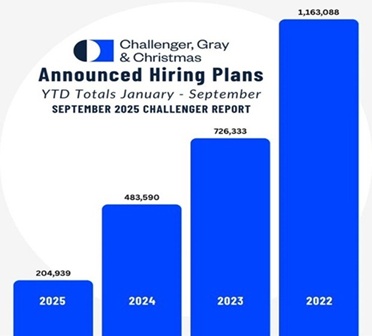
3. Reduced Hiring Plans: U.S. employers plan to hire 205,000 new employees in 2025, a 58% drop from 2024 and the lowest year-to-date total since 2009.
4. Services Sector Decline: The Institute for Supply Management reported a fourth consecutive month of shrinking services sector employment in September 2025.
5. Rising Unemployment Payments: Bank of America noted a 10% increase in unemployment payments in October 2025 compared to the previous year.
U.S.-China Trade Tensions
Trade tensions between the U.S. and China intensified at the start of 2025, raising concerns about a potential trade war. Although tensions eased in the second and third quarters, they escalated again in October, with disputes over critical minerals, shipping, and tariffs.
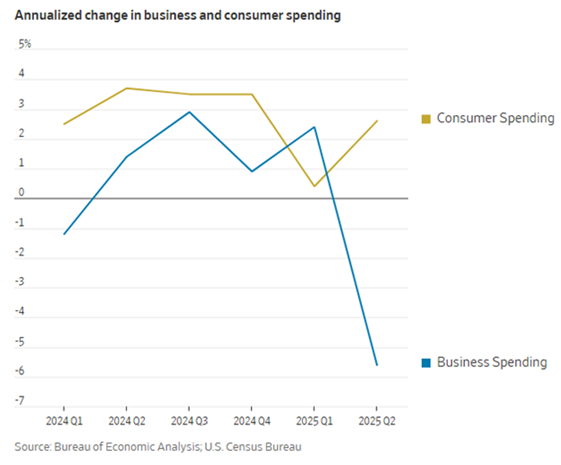
This escalation may be affecting the U.S. economy, as evidenced by a widening gap between consumer and business spending. The reduction in business spending suggests that companies are adopting a more cautious approach.
Federal Reserve Response
On September 17, 2025, the Federal Reserve cut interest rates by 25 basis points to a range of 4.00–4.25% to address labor market weakness. The Fed’s Summary of Economic Projections indicates a year-end target range of 3.50–3.75%, suggesting two additional quarter-point cuts in 2025.
Additionally, recession concerns may intensify, particularly given signs of vulnerability in the Leading Economic Indicators (LEI). The Fed may even consider larger half-point cuts.
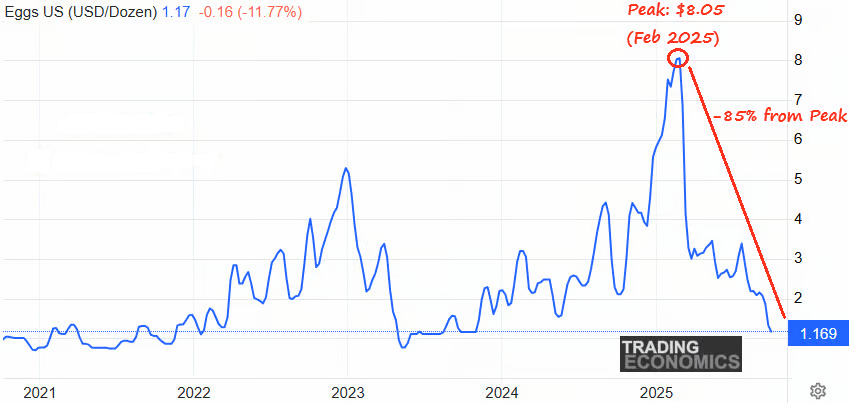
While some argue that inflationary pressures might limit further rate cuts, inflation typically becomes less concerning when unemployment rises or businesses face challenges. Notably, some inflationary trends, such as the earlier “Eggflation” phenomenon, have significantly subsided.
AI Frothiness
Artificial Intelligence (AI) raises several concerns for investors:
1. AI Revenues: Despite hundreds of billions invested in AI, the anticipated corporate sales boom may not materialize as expected.
2. AI Data Centers: Data centers supporting AI are competing with consumers and businesses for electricity, potentially driving up electric prices and prompting consumers to reduce spending in other areas.
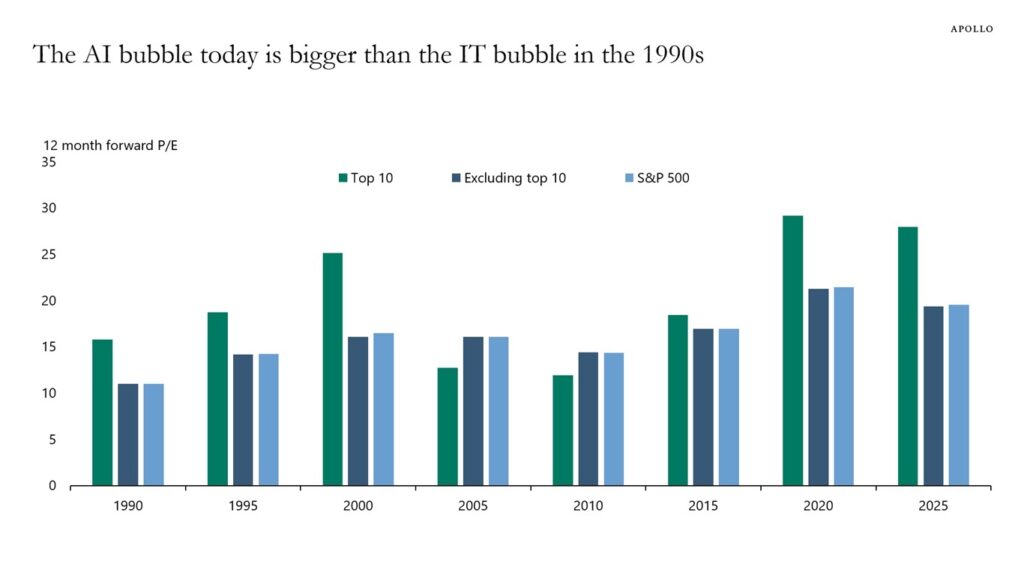
3. AI Overvaluation: The top 10 companies in today’s stock market are more overvalued based on traditional metrics than the top 10 were in the 1990s. The tech bubble’s collapse in the late 1990s led to losses exceeding 75% for many dot-com companies, raising concerns about similar risks today.
Stock Market Trends
Despite the plethora of categorical data that can sway investor feelings, we remain steadfast with our unemotional investment philosophy.
Technical price movements continue to be favorable. The most recent monthly closing price finished above the longer-term trendline, and its slope remains positive. (See the green dot and blue trendline in the chart below.)
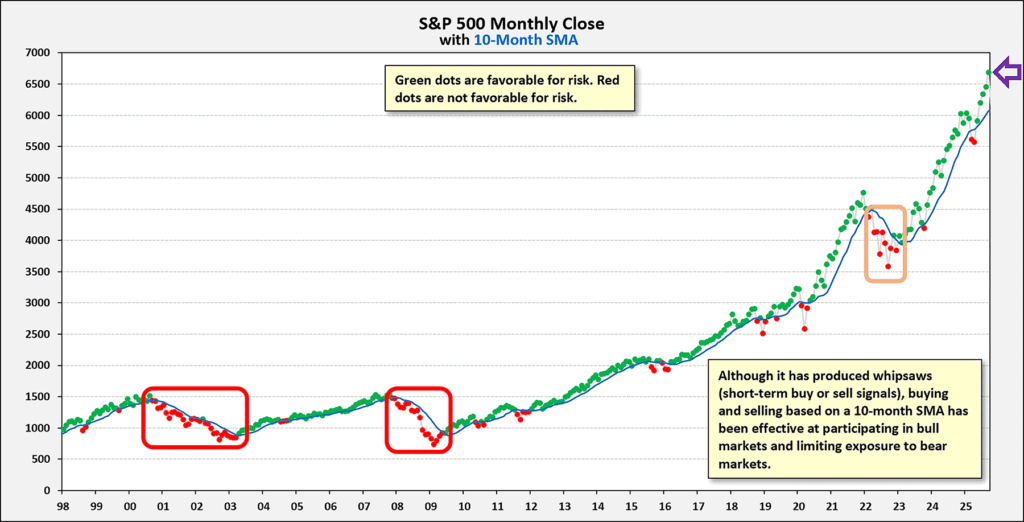
In line with Pacific Park’s discipline, we will reduce our stock allocation if the blue trendline’s slope shifts from positive to negative and if we receive a red dot alert indicating that the monthly closing price has fallen below its longer-term trend. We would also raise cash for protective purposes.
Please contact us if you would like to discuss your portfolio. We would love to review your personal goals and highlight our unique approach to growth and income.
Warmest Regards,
Gary Gordon, MS, CFP
President